A custom desk calendar is one of the few promotional items that stays in front of someone every working day for a full year, but the buying decision hides more choices than it first appears. Format, sheet size, binding, paper weight, and order quantity all interact, and getting them wrong means either a calendar that tips over on a crowded desk or an invoice that comes in far higher than it needed to. This walkthrough covers how to specify each of those decisions in order, so the print file you approve matches the product you actually want.
Choose the format before you touch the artwork
The format decides everything downstream, so settle it first. The most common desktop style is the tent calendar, a folded card that pops up into a self-standing A-frame with a wire loop or spiral along the top edge and twelve or thirteen printed leaves. It needs no stand and packs flat, which is why it dominates the promotional market. The desk strip, sometimes sold as a table calendar, is a longer, shallower version that leaves a band of space beside the date grid for a logo, phone number, or a monthly photo. A desk pad or blotter calendar is a different animal entirely: a large sheet, commonly 22 by 17 inches, that lies flat and doubles as a writing surface, replaced month by month. Standing easel calendars sit somewhere between a desk and a wall product, using a folded cardboard back to prop a taller block of pages.
Each format implies a different use. A tent calendar suits a reception desk or a giveaway where the recipient will not assemble anything. A blotter suits someone who writes appointments by hand and wants the whole quarter visible. Deciding this first keeps you from designing a beautiful layout for the wrong canvas.
Match the size to the space it will occupy
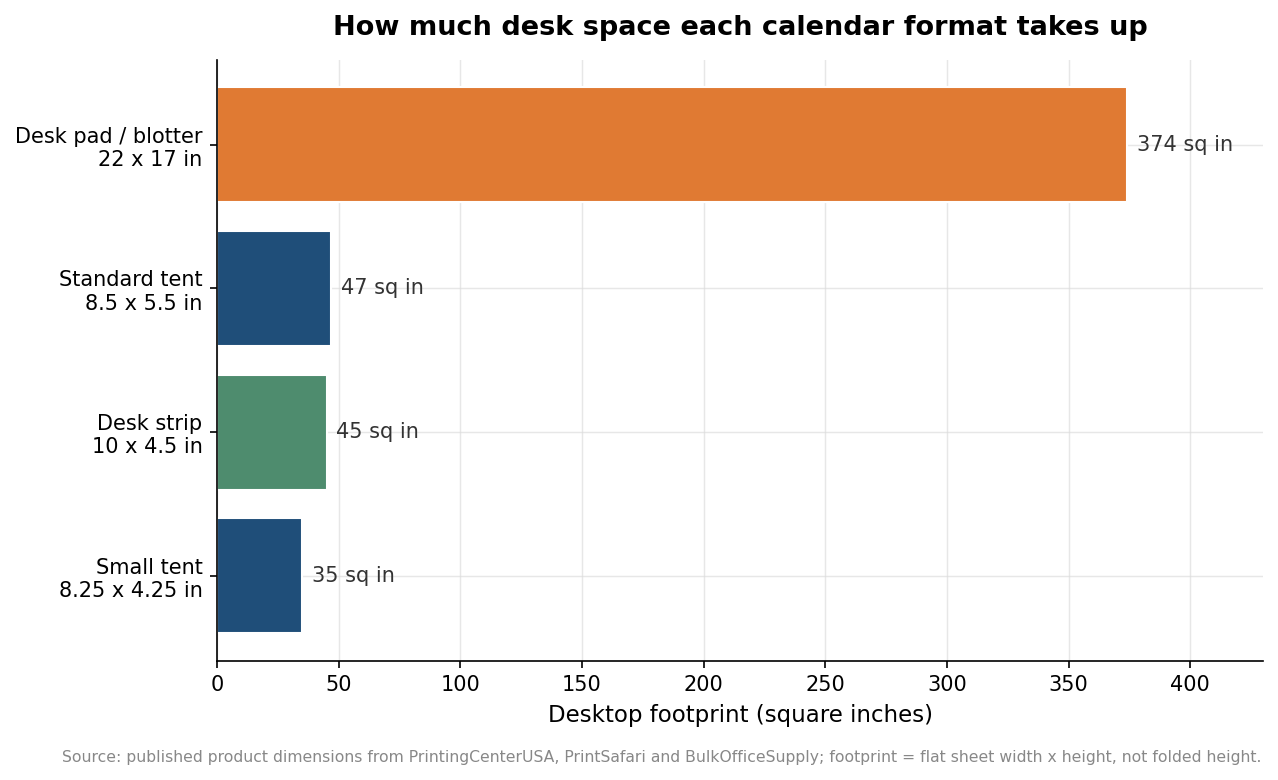
Desktop calendars cluster around a handful of standard sizes, and the differences are more meaningful than the small numbers suggest. Two of the most widely printed tent footprints are roughly 8.5 by 5.5 inches and a more compact 8.25 by 4.25 inches, while the desk strip commonly runs about 10 by 4.5 inches. The wider 10-inch strip earns its length: it keeps room for holidays and a dedicated advertising or image area alongside the grid, whereas the smaller 8.5 by 5.5 block tends to fit only the dates and a picture. At the other extreme, the desk pad’s 22 by 17 inches is not really competing for the same corner of the desk at all.
The practical takeaway is to think in terms of desktop footprint rather than page count. The chart below compares the flat sheet area of four common formats, and the gap between a tent calendar and a blotter is close to tenfold. If desks in your audience are cramped, the smaller tent formats are the safe default; if the calendar is meant to be a working surface, the blotter’s size is the point.
Paper, binding, and how many sheets
Most desktop calendars are bound along the top with Wire-O or a plastic spiral coil, which lets each month flip cleanly and lie back without tearing at the holes. Wire-O gives the tidier, more finished look and is the more common choice on tent and strip formats. Underneath the printed leaves sits a stiffer backer, usually a cardboard or heavy cover sheet that provides the rigidity the calendar stands on.
Paper weight is where quality becomes visible. Interior leaves are frequently printed on a heavy book stock in the range of about 100 to 120 pound text, which resists curling and takes color well, while covers and backers step up to a cover-weight sheet, often something like 80 to 100 pound gloss cover. You will also choose a finish, typically a gloss or a matte coating; gloss makes photographs pop, while matte reads as more restrained and is easier to write on if the calendar has a notes area. On sheet count, a twelve-month calendar is usually built as thirteen leaves, a cover plus one per month, and sometimes fourteen when a separate title or planning page is added ahead of January. Confirm whether printing is one-sided or two, since a full-color front with a blank back costs less than color on both faces.
Quantity and lead time drive the real cost
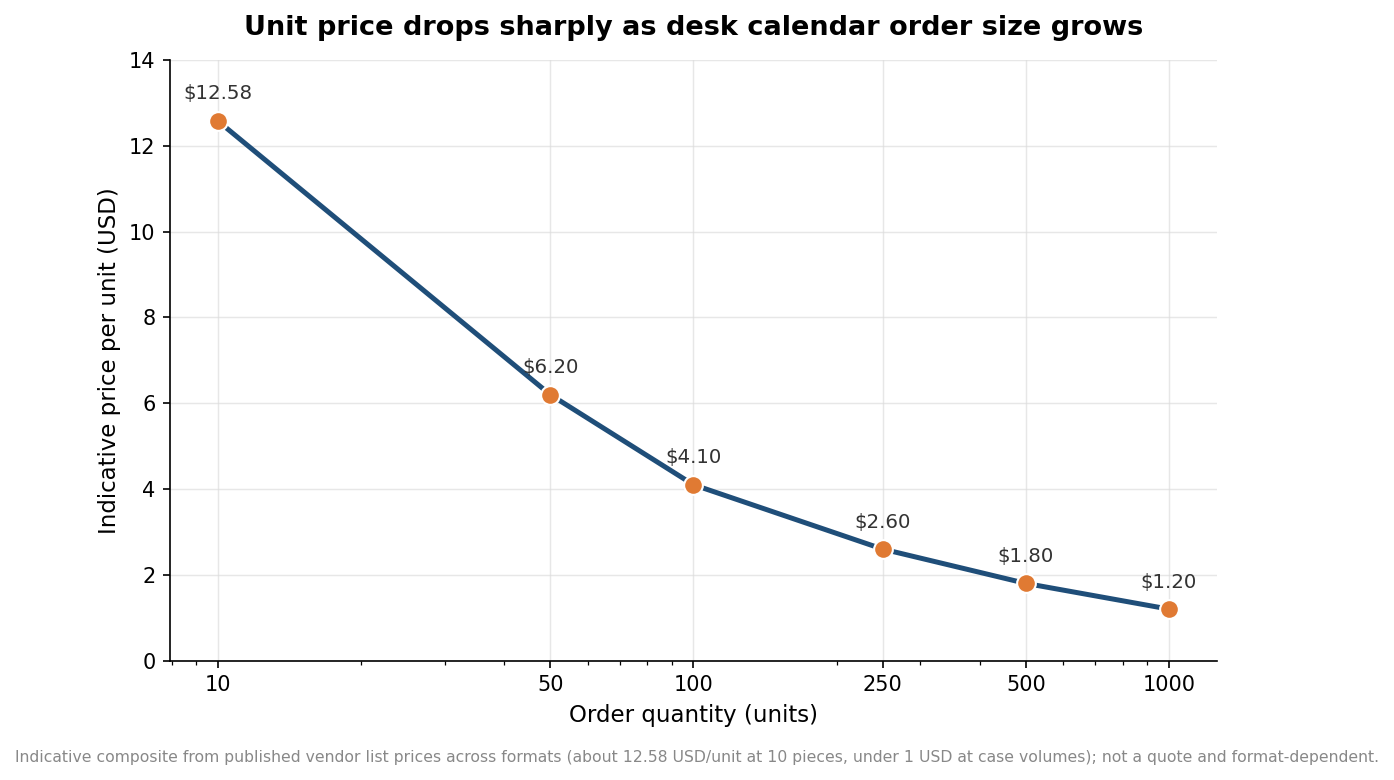
Unit price on desk calendars is dominated by quantity, and the curve is steep at the low end. Published list prices show small runs landing around 12 to 13 dollars per unit at ten pieces, with the per-piece figure falling quickly into the low single digits as the order climbs into the hundreds, and dropping under a dollar at case and thousand-piece volumes. The chart below traces that indicative decline; treat it as a shape rather than a quote, because the exact numbers move with format, page count, and finish. The lesson is that ordering slightly more than you think you need is often nearly free per unit, while ordering a handful is expensive per unit.
Minimum order quantities vary widely by product. Some online printers will produce a single desk calendar, while promotional and wholesale lines often start at a case, and blotter products are sometimes sold only by the case of several dozen. Build lead time into the plan as well. Production typically begins once a print-ready file is approved, and many printers start the clock only if files arrive before a mid-morning cutoff. A realistic window for a standard run is on the order of one to three weeks from file approval to delivery, with shipping counted separately from production, and proofing adding a day or more if you want to see the artwork before the press runs. Because desk calendars are dated, this timing is unforgiving: a January-dated product ordered in December leaves no room for a reprint, so the safe move is to lock artwork well ahead of the season.
Putting the specification together
A complete desk calendar spec answers six questions in plain terms: which format, what flat size, what binding, what interior and cover paper with which finish, how many leaves printed on how many sides, and what quantity against what in-hand date. Decide the format and size for the desk it will live on, pick paper heavy enough that the pages do not curl, and let quantity be guided by the fact that the per-unit price rewards a larger run. Where a figure here is described as indicative, it reflects a range across vendors rather than a fixed rate, so use it to frame your questions to a printer rather than as a final number. Specified in that order, the calendar you approve on screen is the one that will sit on a desk twelve months from now.