Two desk calendars can look identical in a mockup and feel like different products in the hand. The gap is almost always the paper and the way it is bound, not the artwork. Page stock decides whether a month feels flimsy or substantial and whether a pen glides or beads up. The backer decides whether the calendar stands at a confident angle or slumps by March. If you are ordering in bulk and specifying a job rather than buying off a shelf, the material choices below are where the money and the impression actually live.
Why paper weight is the first decision
Paper is sold by weight, and in the United States that weight is quoted in pounds tied to a grade: text stock for pages, cover stock for backers and rigid panels. The rest of the world uses grams per square meter, or gsm, which is cleaner because it is one scale for everything. For a desk calendar the page sheets typically live in the 80 lb to 100 lb text range, roughly 118 to 148 gsm, heavy enough to stop show-through from the month behind but light enough to flip easily. The backer that props the calendar up is cover stock, usually 100 lb to 120 lb cover, about 270 to 325 gsm, chosen for stiffness rather than feel.
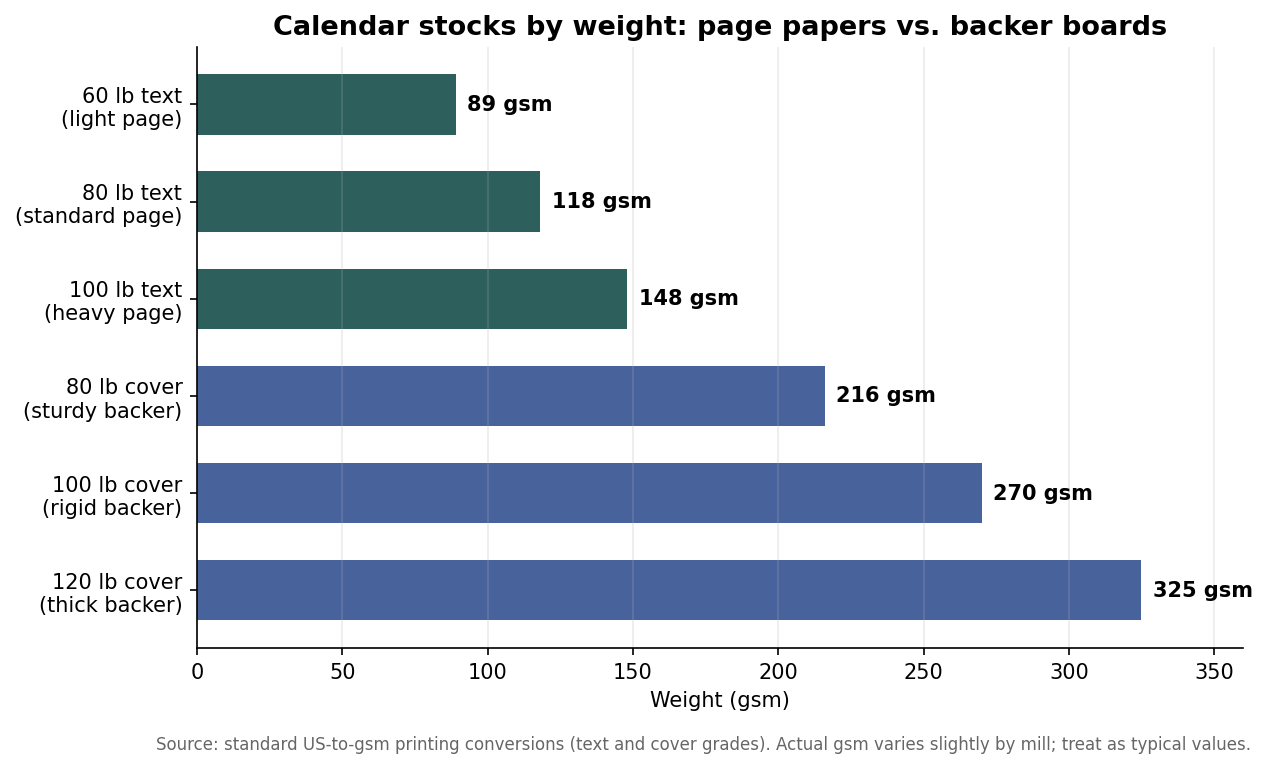
If you remember one conversion, make it this: text and cover are not the same ruler. That single fact causes more ordering mistakes than any other, so it is worth its own section.
The pound trap: why “100 lb” is not one thing
American paper weights are measured by how much a ream weighs at that grade’s basis size, and text and cover grades use different basis sheets. The practical result is that a 100 lb cover sheet is far heavier and thicker than a 100 lb text sheet, roughly 270 gsm against 148 gsm. Order “100 lb paper” for your pages without saying text, and you may receive a stock nearly twice as heavy as you pictured, one that resists flipping and drives up shipping weight across a bulk run.
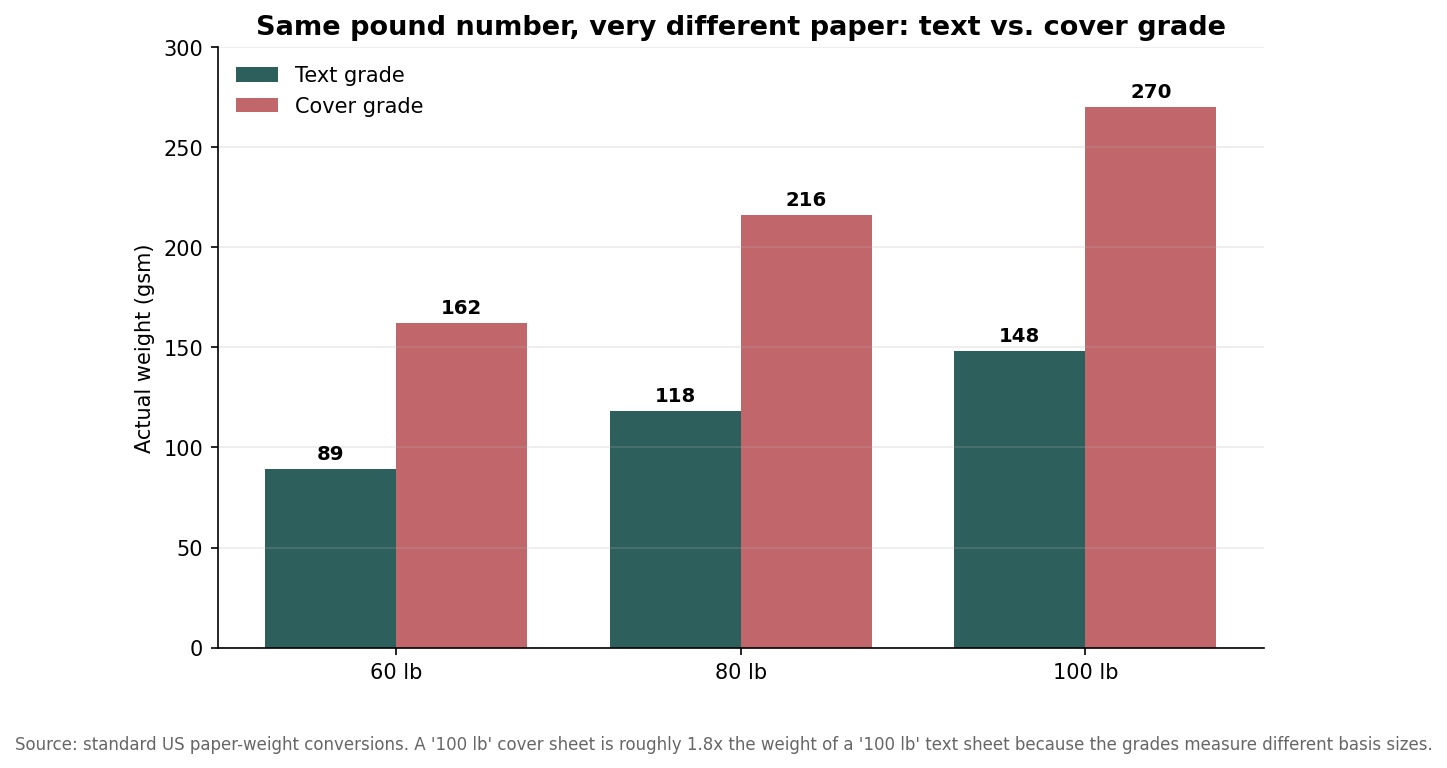
The fix is simple discipline: always pair the number with the grade. Say 100 lb text for pages and 100 lb cover for the backer, or sidestep the whole trap by quoting gsm, which any printer will understand without translation.
Coated, uncoated, or coated one side
Coating is the difference between a calendar you look at and one you write on. Coated stock, in gloss, satin, or matte, gives punchy photographic color but fights a ballpoint and smears a gel pen. Uncoated stock takes ink and pencil beautifully but renders photos a little flatter and duller. For a desk calendar people actually mark up, the quiet winner is often coated one side, known as C1S: the coated face carries a sharp printed grid or image, and the uncoated back accepts notes. If your calendar is a display piece first and a writing surface second, full coating is fine; if staff will scribble on it daily, uncoated or C1S will age far better.
Binding and the base that holds it up
Most desk calendars are bound at the top with a metal wire-o or a plastic spiral coil. Both let pages turn a full 360 degrees and lie flat, which matters on a crowded desk. Wire-o tends to read as more finished and corporate and holds its shape; plastic coil is cheaper, comes in colors, and shrugs off being crushed in a drawer. Saddle stitch, where folded sheets are stapled through the spine, shows up on booklet-style calendars but is less common for the classic standing desk format.
The base is the part buyers forget until a calendar face-plants. An easel backer is usually chipboard, a dense recycled board around 30 points thick, laminated or wrapped so it resists warping. Too thin and the calendar tips forward under its own page weight; too thick and it adds cost and bulk to every unit in a bulk order. If your calendar has to stand unsupported on a desk for twelve months, the backer stiffness is not a detail to leave to chance.
Finishes that change how it feels and prints
Finishing is where a calendar earns its keep as a year-long branded object. UV coating adds a hard, glossy or matte sheen that protects the print but nearly eliminates writeability, so it belongs on covers and display panels rather than writing grids. Soft-touch lamination gives a velvety, low-luster surface that resists fingerprints and feels premium, a popular choice for the cover of a gift calendar. Plain matte or satin varnish sits in between, knocking down glare without the plastic feel. Whatever you choose, keep the finish off any surface meant for a pen, and confirm the ink and coating are compatible so heavy solids do not scuff during assembly.
Put the pieces together before you request a quote: page stock in gsm or a grade-qualified pound weight, a coating that matches how the calendar will be used, a binding that suits the desk it will live on, and a backer stiff enough to stand all year. Prices and lead times move with paper choice, coating, and run size, so treat any single figure as indicative and lock it on a written quote. Specify the materials clearly and two identical-looking mockups stop being a gamble, because you already know which one will still be standing on the desk in December.