A custom desk calendar is one of the few marketing items a customer will keep on their desk for a full year and look at almost every working day. That is exactly why the format you choose matters more than most buyers expect. A calendar built for a law firm’s client gift is the wrong tool for a plumbing company’s counter giveaway, and both differ from what a nonprofit needs for a bulk mailing. This guide works backward from the goal so you order the version that actually gets used.
Start with the goal, not the format
Before comparing paper weights or binding styles, decide what the calendar is supposed to do. There are four common jobs: a premium client gift meant to signal that you value the relationship, a top-of-mind advertising piece that keeps your phone number in front of a buyer, a functional planning tool for internal teams, and a retail or fundraising product that has to sell or be handed out in volume. Each goal points to a different size, format, and budget, and trying to make one calendar serve all four usually produces something that serves none of them well.
The reason a calendar is worth the effort at all comes down to attention. Industry surveys of promotional products consistently find that most people keep an item they consider useful, and that receiving one leaves a more favorable impression of the advertiser. In the 2026 ASI Ad Impressions Study, roughly two-thirds of U.S. consumers said they would keep a promotional item because it was useful, nearly 80% reported a more favorable impression of the advertiser, and about three in four said they were more likely to do business with a company that gave them one. A desk calendar is close to a best case for that dynamic, because usefulness and daily visibility are built into the format.
The marketing case over a one-off giveaway
Promotional advertising is usually measured in cost per impression, and the numbers are striking once an item is kept. The same ASI research puts the cost of a single impression on common kept products at a fraction of a cent. A desk calendar does not carry a published single figure, but its economics are unusually favorable: it stays in view for about twelve months and gets glanced at daily, so the handful of dollars it costs is spread across an enormous number of low-cost exposures. Contrast that with a giveaway that gets used up in a week or slid into a drawer, and the calendar’s advantage is the sheer duration of the exposure rather than any one dramatic moment.
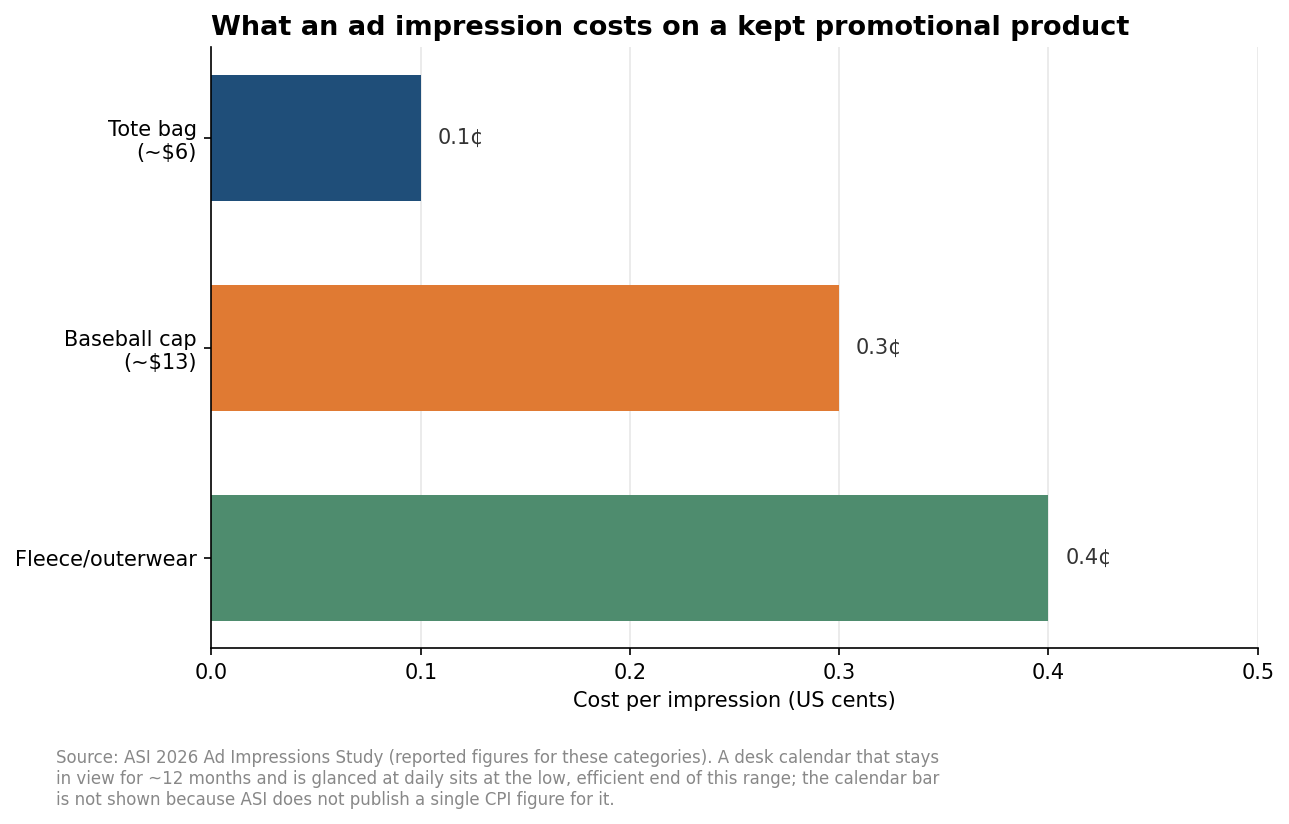
The practical takeaway: a calendar earns its cost through longevity, so the design choices that keep it on the desk are the ones that protect the investment. A cramped layout, an unfamiliar format, or artwork that reads as an advertisement rather than a useful tool are the fastest ways to lose those daily impressions to a shelf.
Matching format to industry and goal
Professional services such as law, accounting, insurance, and real estate lean toward an easel or tent style, or a standing monthly pad with room to jot appointments. These are relationship businesses, so the calendar doubles as a client gift, and heavier cover stock, a matte or soft-touch finish, and restrained branding carry the premium feel that the relationship is meant to signal.
Trades and field services like HVAC, plumbing, electrical, and landscaping are better served by a tear-off block or a large monthly wall-adjacent pad with generous date squares. The buyer here wants your phone number legible from across a garage or job trailer, and the calendar has to survive a working environment, so durability and a bold, high-contrast layout beat subtlety.
Healthcare and dental practices benefit from a monthly pad format that patients and staff can write appointments on directly. A clean, uncluttered grid, plenty of writing room, and a calm color palette fit the setting and make the piece something the front desk actually keeps out.
Retail and hospitality often do best with a compact standing card or a small easel for counters and reception desks, where space is tight and the calendar competes with point-of-sale clutter. Brand-forward artwork works here because the goal is recognition at a glance rather than a planning surface.
Nonprofits and membership organizations typically need a year-at-a-glance or thin monthly format that highlights key dates such as events, renewal deadlines, or giving days, produced at a low per-unit cost so a bulk mailing stays affordable. The calendar is both a thank-you and a soft reminder of the next thing you want the recipient to do.
Quantity, budget, and when to order
Unit cost falls as quantity rises, and format drives the rest of the price. As a rough market guide rather than a specific quote, simple compact and pad-style desk calendars tend to sit at the lower end of the range while easel, tent, and premium-stock pieces cost more per unit; the exact figure depends on paper, coatings, page count, and how many you order. Treat any single number you see online as indicative until it is tied to your actual specification and quantity.
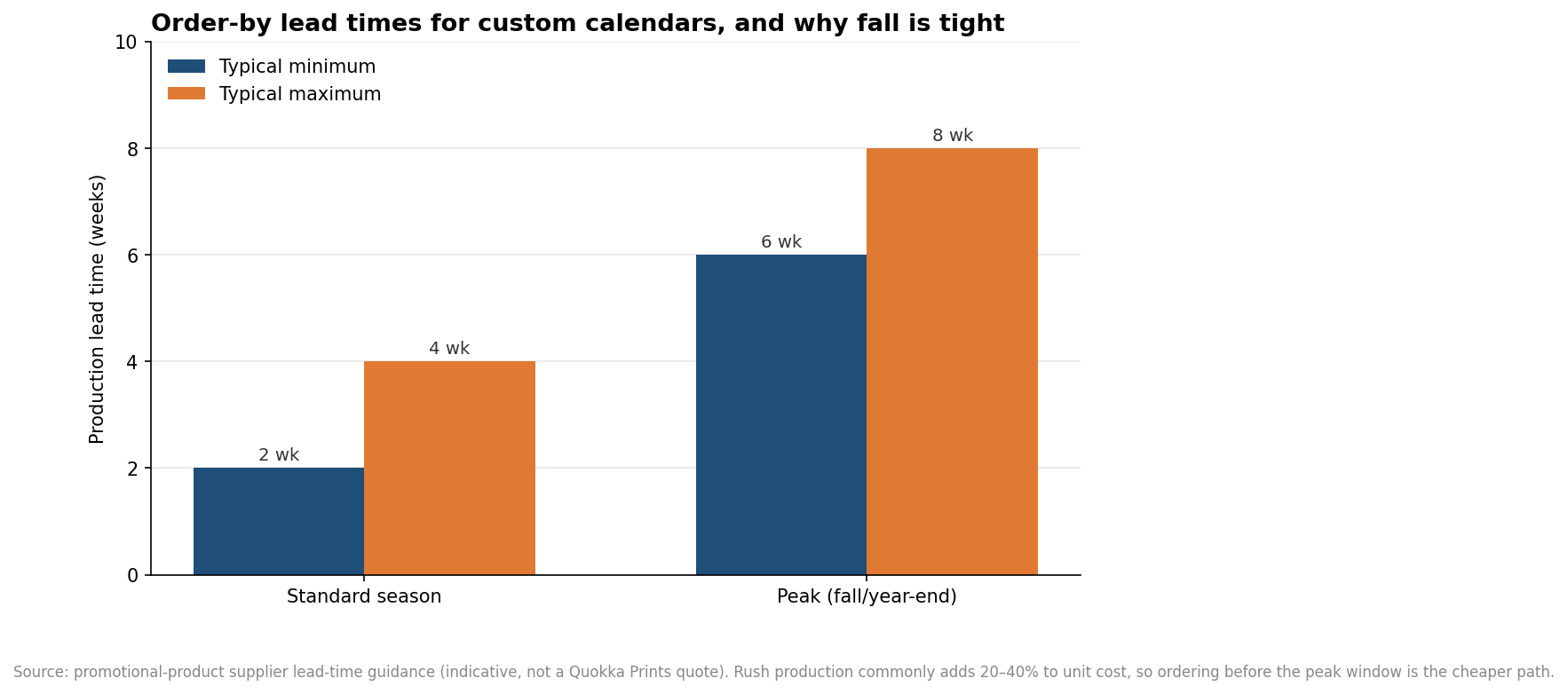
Timing is where most calendar orders go wrong. Standard production commonly runs two to four weeks, but the fall and year-end window that everyone competes for can stretch that to six to eight weeks as printers fill up. Rush production is available but frequently adds 20% to 40% to the unit cost, which erases the savings that made a bulk calendar attractive in the first place. If you want calendars in recipients’ hands before the new year, the comfortable order window is late summer to early fall, not December.
A quick way to decide
Name the single job first: gift, advertising, planning tool, or bulk handout. Let that choose your format before you touch paper and finish options, because an easel gift and a tear-off advertising block are genuinely different products. Then size the quantity to your list, price it against a real specification, and place the order early enough to stay out of the peak-season rush. Do those four things in order and the calendar will do what it is uniquely good at: keep your name in front of the right person, every working day, for a year.