A desk calendar is unforgiving in a way most promotional products are not: it has a hard expiration date printed on the cover. A coffee mug that ships in February is still a good mug, but a calendar that arrives in February has already lost a sixth of its useful life, and one with a typo in the date grid is wrong three hundred and sixty-five days a year. The good news is that almost every disappointing calendar order traces back to a short list of avoidable mistakes. Here are the ones worth guarding against, roughly in the order they tend to bite.
Starting too late for a product with a deadline
The single most common mistake is treating a dated product like an undated one. Because the calendar has to be useful from the first week of January, every step behind it has to finish before then, and those steps stack up faster than people expect. You need time to settle the concept and lay out artwork, time for at least one proof cycle, time for printing and finishing, and time to ship and physically distribute to desks. The chart below lays out an indicative backward timeline, counting weeks before the calendars need to be in front of people. Treat the windows as planning guidance rather than promises, since real lead times shift with quantity, finishing, and how busy the print calendar is in the fall, but the shape holds: begin in the quarter before, not the month before.
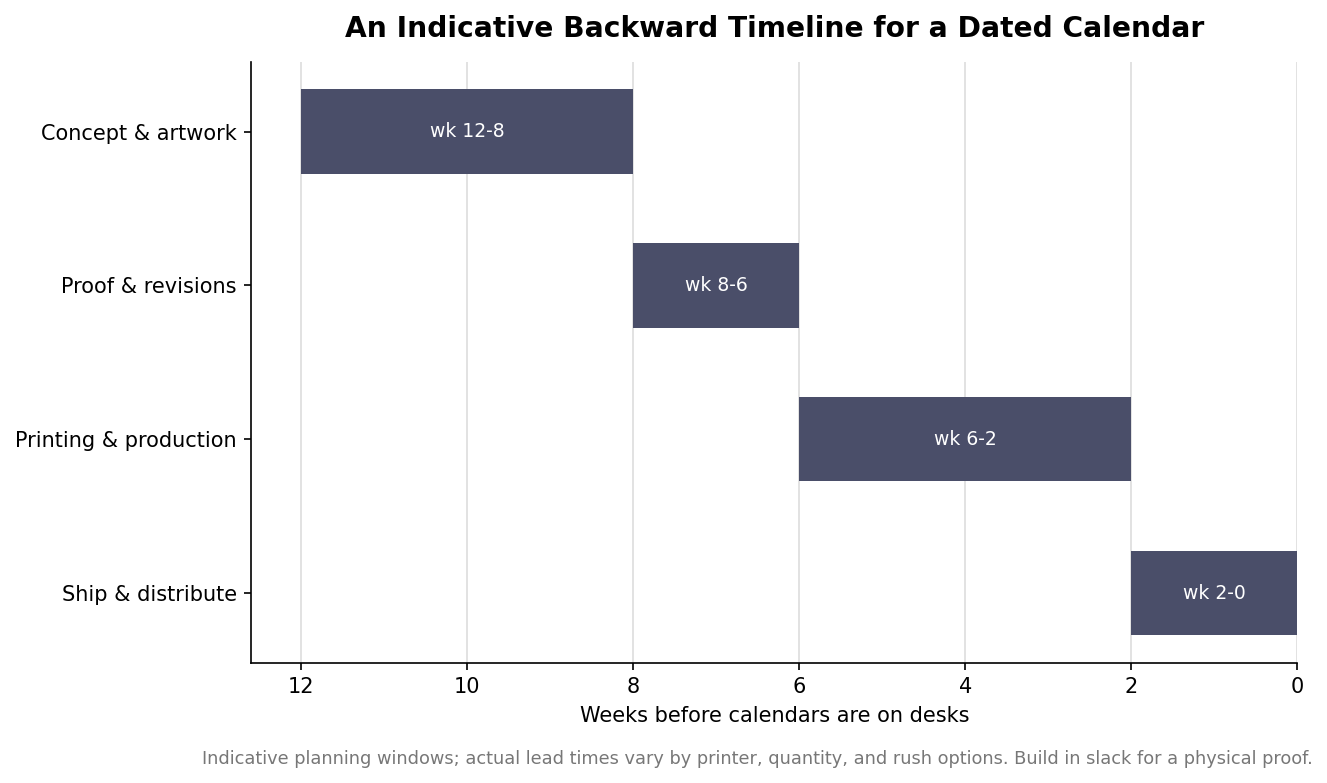
The practical rule that falls out of this is to start concept work around the end of summer for a January launch, and to add a buffer if you want a physical proof rather than a screen proof. Rush production exists, but it costs more and removes the slack you would otherwise have if a proof comes back wrong.
Approving the artwork without auditing the dates
The second mistake is proofing the design and forgetting the data. A calendar grid is not just a layout, it is a table of facts, and every one of those facts can be wrong. Check that the year is correct throughout, that each month starts on the right weekday, that the week begins on the day your audience expects, whether that is Sunday or Monday, and that holidays are both present and dated correctly for the regions that will receive it. Moving holidays and observances are a frequent trap, and so are leap years. Read the proof for content, not just for how the photograph looks, and if the calendar ships internationally, confirm the date conventions and holiday set match the destination rather than the office that ordered it. It helps to have someone who did not build the file check the grid, since the person who laid it out tends to read what they meant to type rather than what is actually there. A ten-minute independent audit of the dates is the cheapest insurance in the whole project.
Guessing the quantity instead of forecasting it
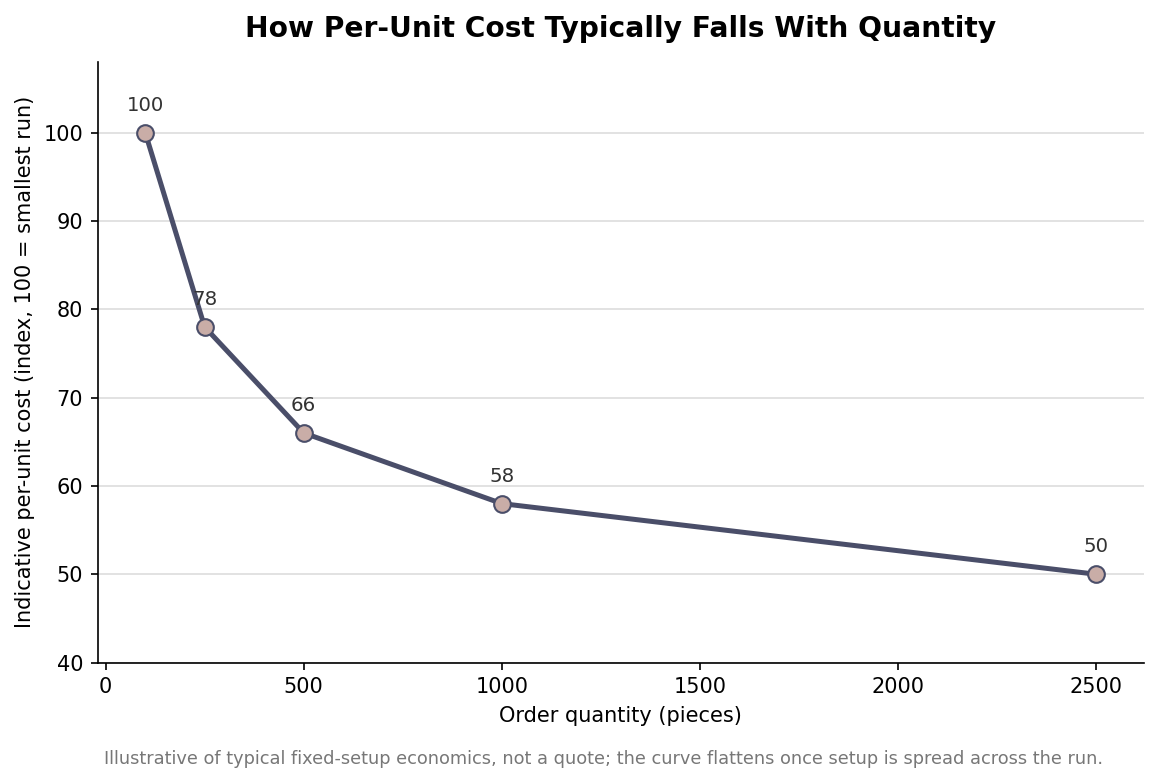
Ordering the wrong number is a quieter mistake that shows up as cost. Order too few and you are back for a short second run at a worse per-unit price, or you leave latecomers and new hires without one. Order far too many and boxes sit in a closet aging toward irrelevance the moment the year turns. The economics push in a specific direction: because the setup cost is fixed, the per-unit price falls steeply as quantity rises and then flattens, as the second chart illustrates with an indicative cost index. The takeaway is not simply to buy more, but to forecast honestly, count the people who will actually keep one on a desk, add a sensible margin for new arrivals and reprints of goodwill, and land on the quantity where the curve has already done most of its flattening.
Choosing a format that fights the desk
A calendar that does not fit the space it is meant to live in gets moved or tossed. An oversized easel calendar is wrong for a shared hot desk, a flimsy pad curls and slides, and a block or tent format that looks great in a mockup can crowd a monitor riser in real life. Match the footprint and the standing height to where it will actually sit, and think about whether the recipient writes on it, glances at it, or flips it. The format decision is a usability decision, and getting it wrong quietly undoes all the money spent on paper and printing. Ask for a physical sample of the format before committing the full run so you are judging the object, not the rendering.
Forgetting how it gets to the desk
The last mistake is designing a great calendar and then not planning its delivery. Distribution is part of the order, not an afterthought. If calendars are mailed, their weight and rigidity drive envelope choice and postage, and a self-mailer or a right-sized mailer can save real money and damage at scale. If they are handed out internally, someone has to own getting them onto desks before the year starts rather than leaving a box in a break room. Decide early whether you are mailing, distributing internally, or both, and build the packaging and the handoff into the same timeline as the printing. If the calendars are going to clients, remember that the mailing date, not the print date, is the one the recipient experiences, so a run that finishes on time but sits on a loading dock for two weeks still arrives late. Handle these five and the calendar does its actual job, which is to sit in plain view for twelve months and keep your name there the whole time.