Category: Uncategorized

  • Which Custom Desk Calendar Fits Your Business? A Use-Case Guide by Goal and Industry

    Which Custom Desk Calendar Fits Your Business? A Use-Case Guide by Goal and Industry

    A custom desk calendar is one of the few marketing items a customer will keep on their desk for a full year and look at almost every working day. That is exactly why the format you choose matters more than most buyers expect. A calendar built for a law firm’s client gift is the wrong tool for a plumbing company’s counter giveaway, and both differ from what a nonprofit needs for a bulk mailing. This guide works backward from the goal so you order the version that actually gets used.

    Start with the goal, not the format

    Before comparing paper weights or binding styles, decide what the calendar is supposed to do. There are four common jobs: a premium client gift meant to signal that you value the relationship, a top-of-mind advertising piece that keeps your phone number in front of a buyer, a functional planning tool for internal teams, and a retail or fundraising product that has to sell or be handed out in volume. Each goal points to a different size, format, and budget, and trying to make one calendar serve all four usually produces something that serves none of them well.

    The reason a calendar is worth the effort at all comes down to attention. Industry surveys of promotional products consistently find that most people keep an item they consider useful, and that receiving one leaves a more favorable impression of the advertiser. In the 2026 ASI Ad Impressions Study, roughly two-thirds of U.S. consumers said they would keep a promotional item because it was useful, nearly 80% reported a more favorable impression of the advertiser, and about three in four said they were more likely to do business with a company that gave them one. A desk calendar is close to a best case for that dynamic, because usefulness and daily visibility are built into the format.

    The marketing case over a one-off giveaway

    Promotional advertising is usually measured in cost per impression, and the numbers are striking once an item is kept. The same ASI research puts the cost of a single impression on common kept products at a fraction of a cent. A desk calendar does not carry a published single figure, but its economics are unusually favorable: it stays in view for about twelve months and gets glanced at daily, so the handful of dollars it costs is spread across an enormous number of low-cost exposures. Contrast that with a giveaway that gets used up in a week or slid into a drawer, and the calendar’s advantage is the sheer duration of the exposure rather than any one dramatic moment.
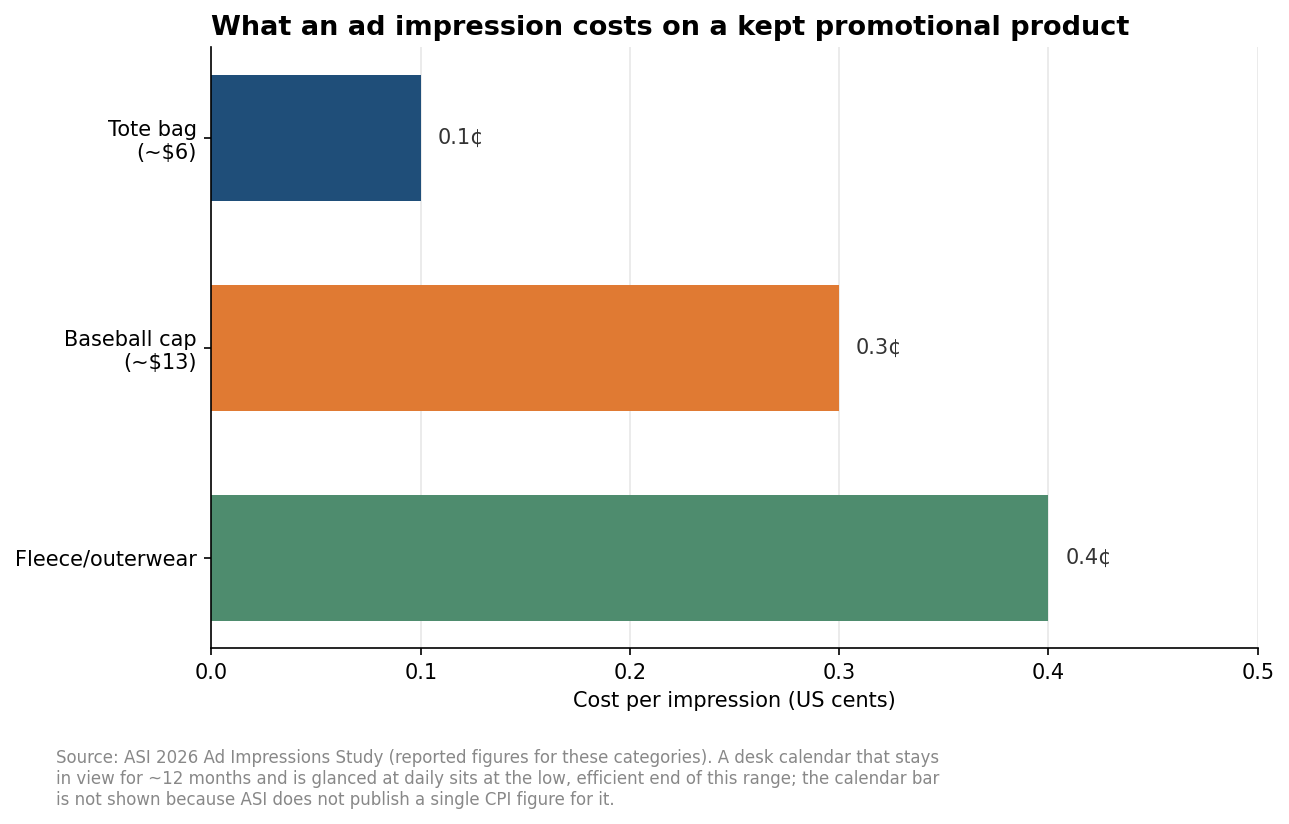
    Horizontal bar chart of cost per impression for kept promotional products: tote bag 0.1 cents, cap 0.3 cents, fleece 0.4 cents
    Kept promotional products cost a fraction of a cent per impression; a calendar’s year-long daily visibility sits at the efficient end.

    The practical takeaway: a calendar earns its cost through longevity, so the design choices that keep it on the desk are the ones that protect the investment. A cramped layout, an unfamiliar format, or artwork that reads as an advertisement rather than a useful tool are the fastest ways to lose those daily impressions to a shelf.

    Matching format to industry and goal

    Professional services such as law, accounting, insurance, and real estate lean toward an easel or tent style, or a standing monthly pad with room to jot appointments. These are relationship businesses, so the calendar doubles as a client gift, and heavier cover stock, a matte or soft-touch finish, and restrained branding carry the premium feel that the relationship is meant to signal.

    Trades and field services like HVAC, plumbing, electrical, and landscaping are better served by a tear-off block or a large monthly wall-adjacent pad with generous date squares. The buyer here wants your phone number legible from across a garage or job trailer, and the calendar has to survive a working environment, so durability and a bold, high-contrast layout beat subtlety.

    Healthcare and dental practices benefit from a monthly pad format that patients and staff can write appointments on directly. A clean, uncluttered grid, plenty of writing room, and a calm color palette fit the setting and make the piece something the front desk actually keeps out.

    Retail and hospitality often do best with a compact standing card or a small easel for counters and reception desks, where space is tight and the calendar competes with point-of-sale clutter. Brand-forward artwork works here because the goal is recognition at a glance rather than a planning surface.

    Nonprofits and membership organizations typically need a year-at-a-glance or thin monthly format that highlights key dates such as events, renewal deadlines, or giving days, produced at a low per-unit cost so a bulk mailing stays affordable. The calendar is both a thank-you and a soft reminder of the next thing you want the recipient to do.

    Quantity, budget, and when to order

    Unit cost falls as quantity rises, and format drives the rest of the price. As a rough market guide rather than a specific quote, simple compact and pad-style desk calendars tend to sit at the lower end of the range while easel, tent, and premium-stock pieces cost more per unit; the exact figure depends on paper, coatings, page count, and how many you order. Treat any single number you see online as indicative until it is tied to your actual specification and quantity.

    Timing is where most calendar orders go wrong. Standard production commonly runs two to four weeks, but the fall and year-end window that everyone competes for can stretch that to six to eight weeks as printers fill up. Rush production is available but frequently adds 20% to 40% to the unit cost, which erases the savings that made a bulk calendar attractive in the first place. If you want calendars in recipients’ hands before the new year, the comfortable order window is late summer to early fall, not December.
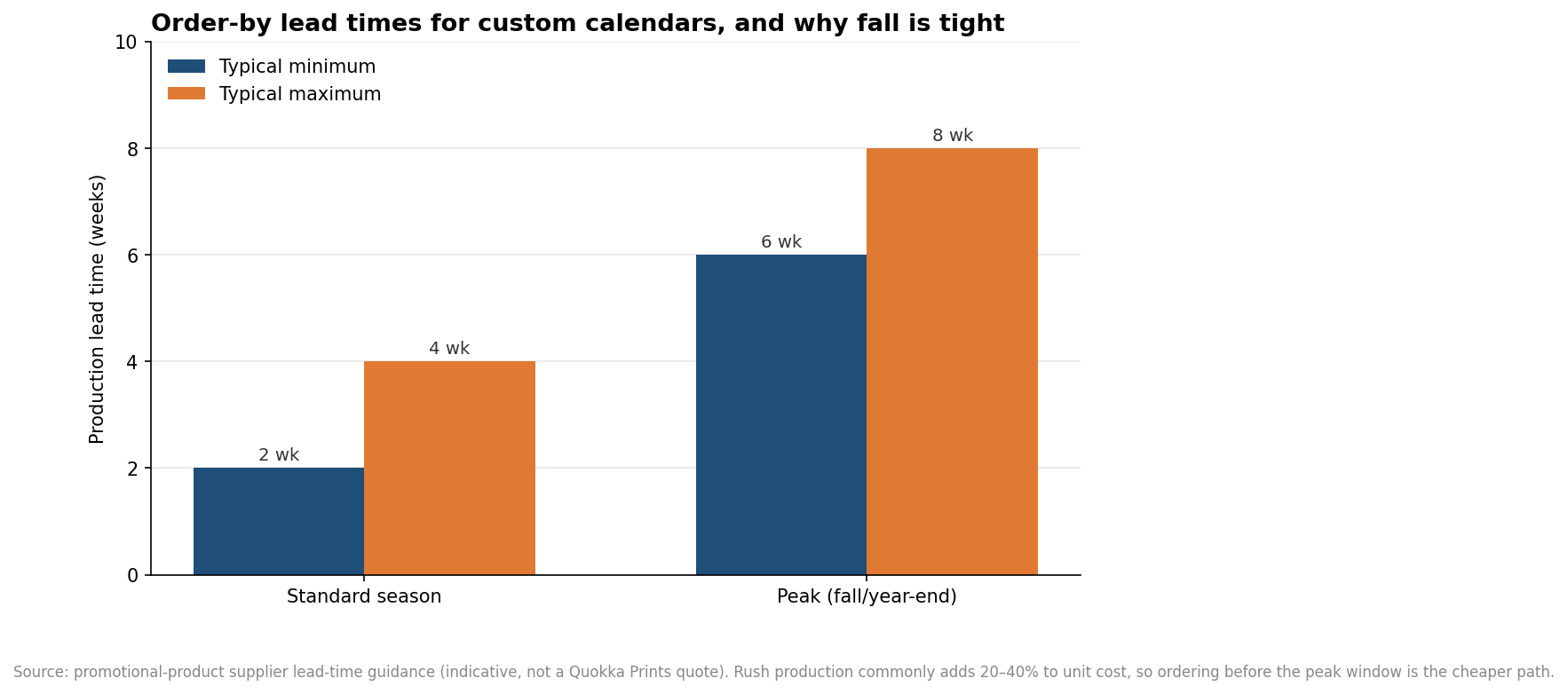
    Grouped bar chart comparing custom calendar production lead times: standard season 2 to 4 weeks, peak season 6 to 8 weeks
    Lead times stretch in the fall rush, and rush production typically adds 20 to 40 percent, so order early.

    A quick way to decide

    Name the single job first: gift, advertising, planning tool, or bulk handout. Let that choose your format before you touch paper and finish options, because an easel gift and a tear-off advertising block are genuinely different products. Then size the quantity to your list, price it against a real specification, and place the order early enough to stay out of the peak-season rush. Do those four things in order and the calendar will do what it is uniquely good at: keep your name in front of the right person, every working day, for a year.
  • The Custom Desk Calendar Ordering Mistakes That Show Up in January

    The Custom Desk Calendar Ordering Mistakes That Show Up in January

    A desk calendar is unforgiving in a way most promotional products are not: it has a hard expiration date printed on the cover. A coffee mug that ships in February is still a good mug, but a calendar that arrives in February has already lost a sixth of its useful life, and one with a typo in the date grid is wrong three hundred and sixty-five days a year. The good news is that almost every disappointing calendar order traces back to a short list of avoidable mistakes. Here are the ones worth guarding against, roughly in the order they tend to bite.

    Starting too late for a product with a deadline

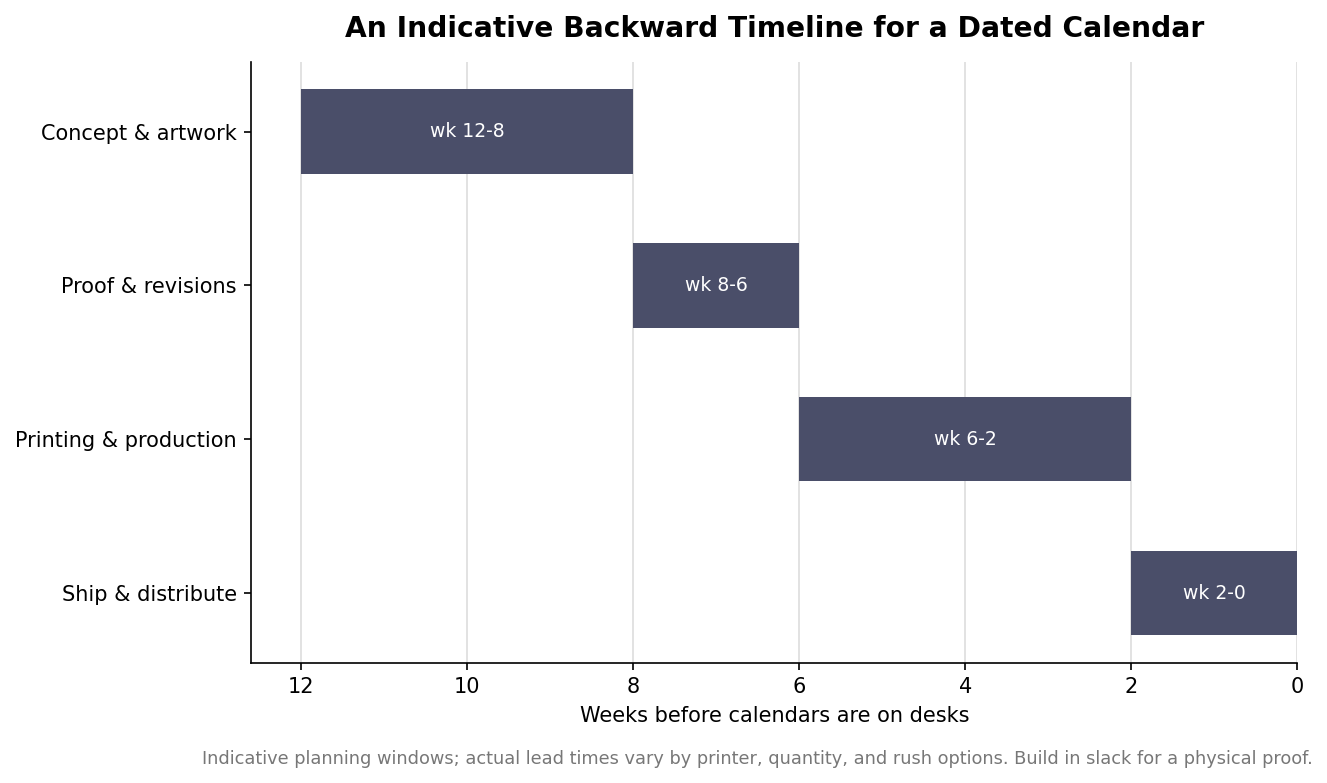
    The single most common mistake is treating a dated product like an undated one. Because the calendar has to be useful from the first week of January, every step behind it has to finish before then, and those steps stack up faster than people expect. You need time to settle the concept and lay out artwork, time for at least one proof cycle, time for printing and finishing, and time to ship and physically distribute to desks. The chart below lays out an indicative backward timeline, counting weeks before the calendars need to be in front of people. Treat the windows as planning guidance rather than promises, since real lead times shift with quantity, finishing, and how busy the print calendar is in the fall, but the shape holds: begin in the quarter before, not the month before.

    Backward timeline chart showing calendar production phases by weeks before calendars are on desks
    An indicative backward timeline: concept through distribution, counted in weeks before launch.

    The practical rule that falls out of this is to start concept work around the end of summer for a January launch, and to add a buffer if you want a physical proof rather than a screen proof. Rush production exists, but it costs more and removes the slack you would otherwise have if a proof comes back wrong.

    Approving the artwork without auditing the dates

    The second mistake is proofing the design and forgetting the data. A calendar grid is not just a layout, it is a table of facts, and every one of those facts can be wrong. Check that the year is correct throughout, that each month starts on the right weekday, that the week begins on the day your audience expects, whether that is Sunday or Monday, and that holidays are both present and dated correctly for the regions that will receive it. Moving holidays and observances are a frequent trap, and so are leap years. Read the proof for content, not just for how the photograph looks, and if the calendar ships internationally, confirm the date conventions and holiday set match the destination rather than the office that ordered it. It helps to have someone who did not build the file check the grid, since the person who laid it out tends to read what they meant to type rather than what is actually there. A ten-minute independent audit of the dates is the cheapest insurance in the whole project.

    Guessing the quantity instead of forecasting it

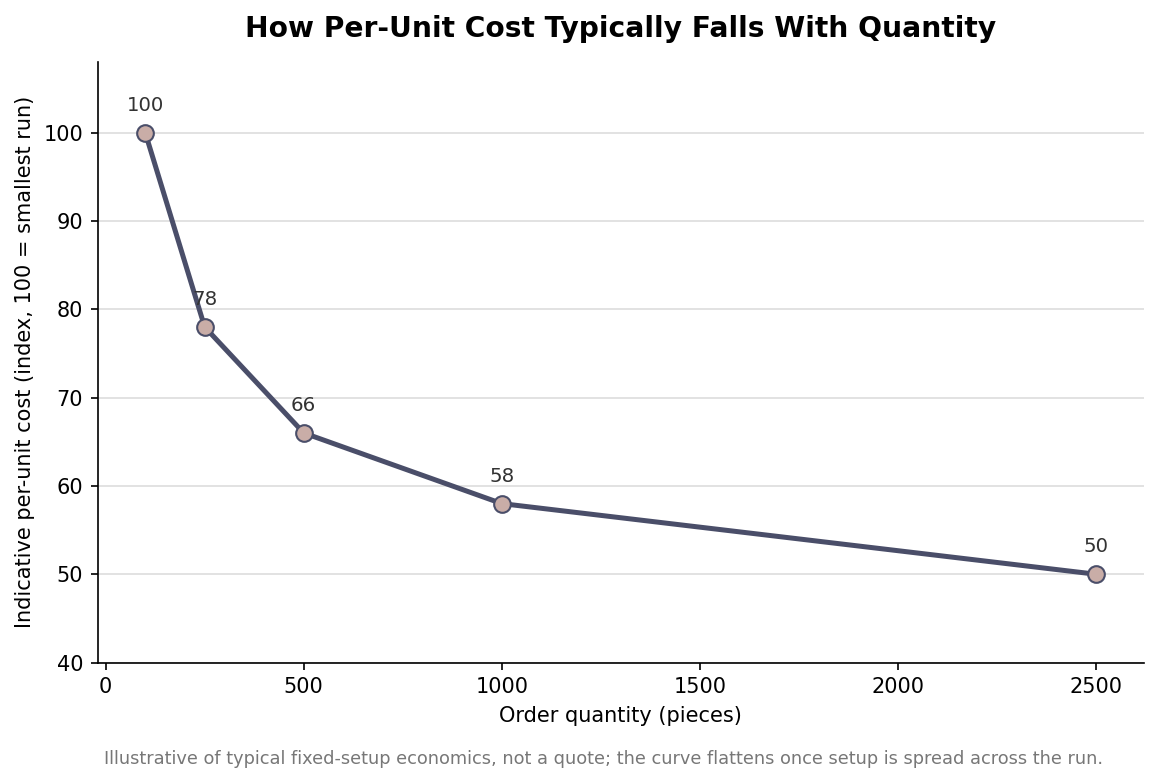
    Ordering the wrong number is a quieter mistake that shows up as cost. Order too few and you are back for a short second run at a worse per-unit price, or you leave latecomers and new hires without one. Order far too many and boxes sit in a closet aging toward irrelevance the moment the year turns. The economics push in a specific direction: because the setup cost is fixed, the per-unit price falls steeply as quantity rises and then flattens, as the second chart illustrates with an indicative cost index. The takeaway is not simply to buy more, but to forecast honestly, count the people who will actually keep one on a desk, add a sensible margin for new arrivals and reprints of goodwill, and land on the quantity where the curve has already done most of its flattening.

    Line chart showing indicative per-unit cost index falling as order quantity rises from 100 to 2500 pieces
    Per-unit cost typically falls steeply then flattens as quantity rises (indicative index).

    Choosing a format that fights the desk

    A calendar that does not fit the space it is meant to live in gets moved or tossed. An oversized easel calendar is wrong for a shared hot desk, a flimsy pad curls and slides, and a block or tent format that looks great in a mockup can crowd a monitor riser in real life. Match the footprint and the standing height to where it will actually sit, and think about whether the recipient writes on it, glances at it, or flips it. The format decision is a usability decision, and getting it wrong quietly undoes all the money spent on paper and printing. Ask for a physical sample of the format before committing the full run so you are judging the object, not the rendering.

    Forgetting how it gets to the desk

    The last mistake is designing a great calendar and then not planning its delivery. Distribution is part of the order, not an afterthought. If calendars are mailed, their weight and rigidity drive envelope choice and postage, and a self-mailer or a right-sized mailer can save real money and damage at scale. If they are handed out internally, someone has to own getting them onto desks before the year starts rather than leaving a box in a break room. Decide early whether you are mailing, distributing internally, or both, and build the packaging and the handoff into the same timeline as the printing. If the calendars are going to clients, remember that the mailing date, not the print date, is the one the recipient experiences, so a run that finishes on time but sits on a loading dock for two weeks still arrives late. Handle these five and the calendar does its actual job, which is to sit in plain view for twelve months and keep your name there the whole time.

  • Paper, Coating, and Binding: What Actually Makes a Desk Calendar Feel Premium

    Paper, Coating, and Binding: What Actually Makes a Desk Calendar Feel Premium

    Two desk calendars can look identical in a mockup and feel like different products in the hand. The gap is almost always the paper and the way it is bound, not the artwork. Page stock decides whether a month feels flimsy or substantial and whether a pen glides or beads up. The backer decides whether the calendar stands at a confident angle or slumps by March. If you are ordering in bulk and specifying a job rather than buying off a shelf, the material choices below are where the money and the impression actually live.

    Why paper weight is the first decision

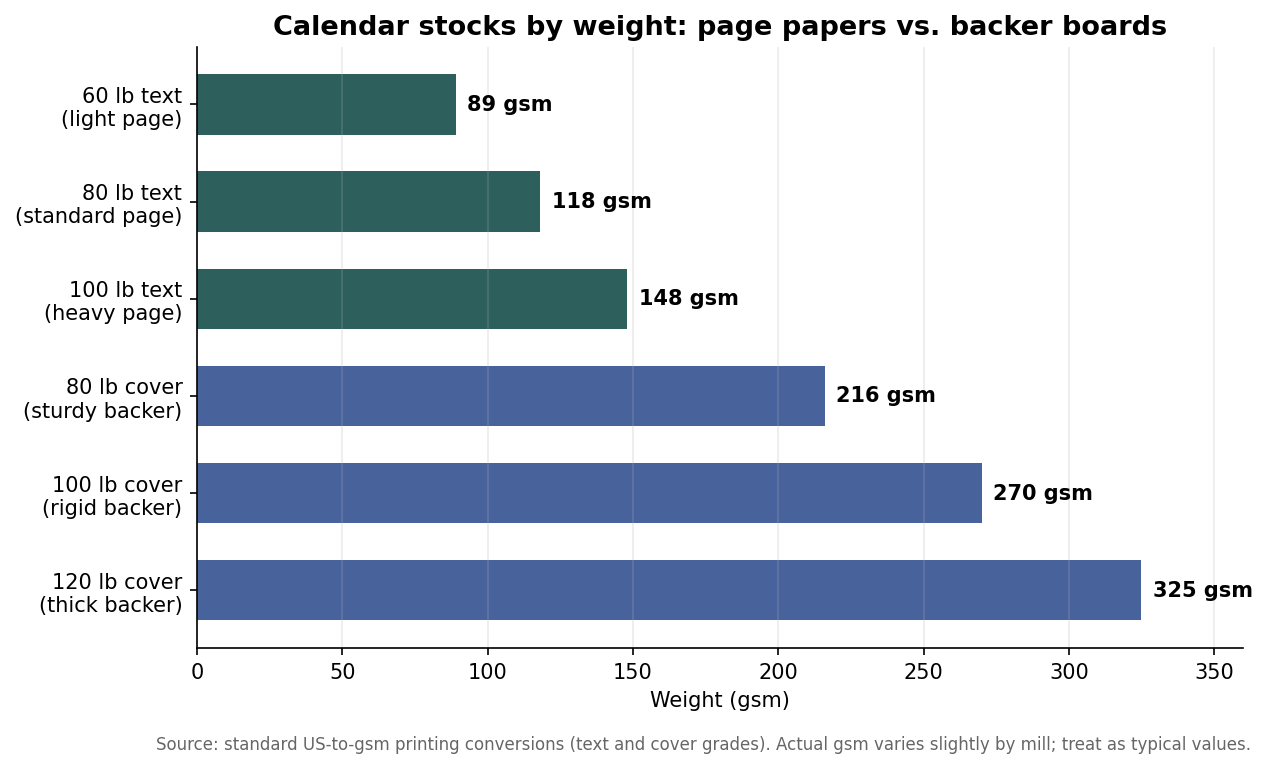
    Paper is sold by weight, and in the United States that weight is quoted in pounds tied to a grade: text stock for pages, cover stock for backers and rigid panels. The rest of the world uses grams per square meter, or gsm, which is cleaner because it is one scale for everything. For a desk calendar the page sheets typically live in the 80 lb to 100 lb text range, roughly 118 to 148 gsm, heavy enough to stop show-through from the month behind but light enough to flip easily. The backer that props the calendar up is cover stock, usually 100 lb to 120 lb cover, about 270 to 325 gsm, chosen for stiffness rather than feel.

    Horizontal bar chart of desk calendar paper weights in gsm for text page stocks and cover backer stocks
    Typical calendar page and backer stocks by weight in gsm.

    If you remember one conversion, make it this: text and cover are not the same ruler. That single fact causes more ordering mistakes than any other, so it is worth its own section.

    The pound trap: why “100 lb” is not one thing

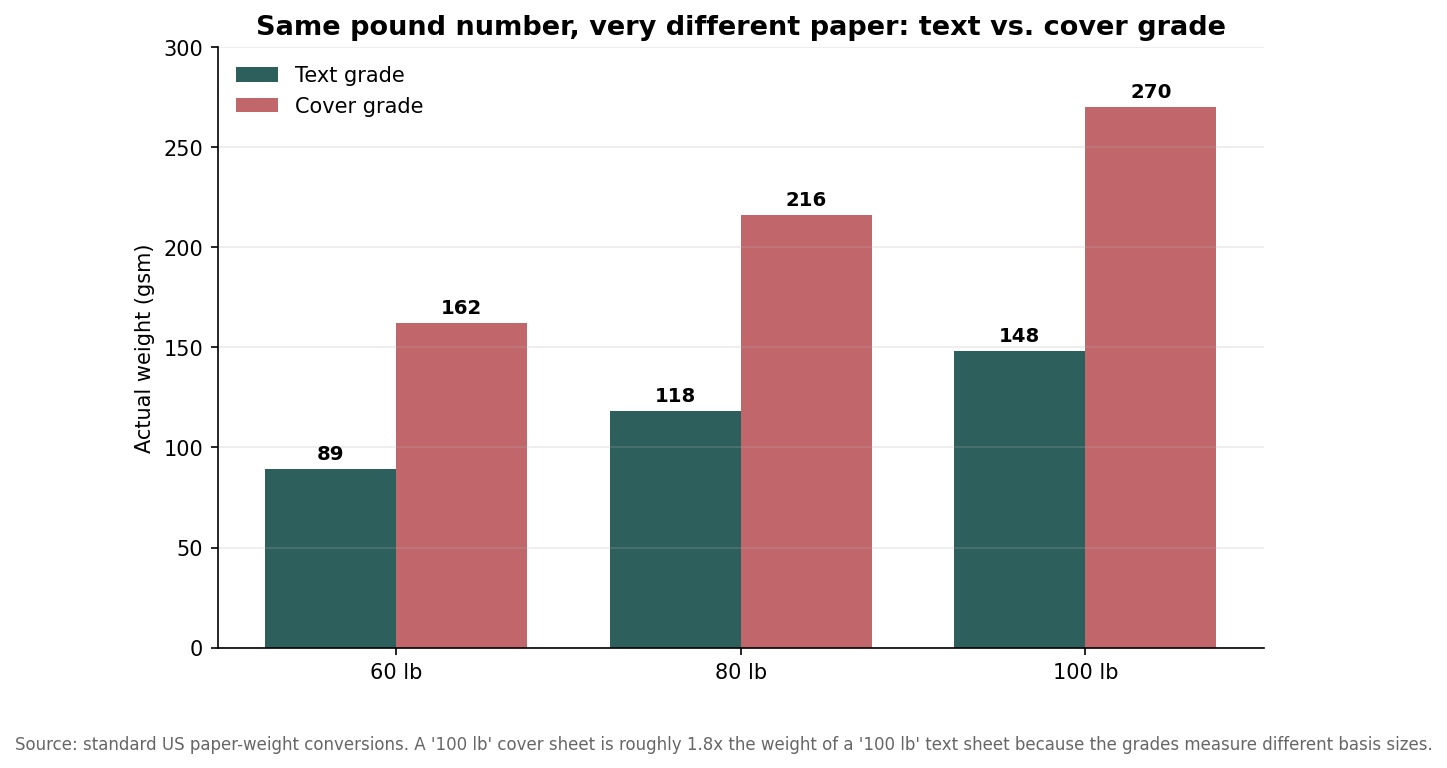
    American paper weights are measured by how much a ream weighs at that grade’s basis size, and text and cover grades use different basis sheets. The practical result is that a 100 lb cover sheet is far heavier and thicker than a 100 lb text sheet, roughly 270 gsm against 148 gsm. Order “100 lb paper” for your pages without saying text, and you may receive a stock nearly twice as heavy as you pictured, one that resists flipping and drives up shipping weight across a bulk run.

    Grouped bar chart showing text grade versus cover grade gsm for 60, 80, and 100 pound papers
    The same pound number lands at very different real weights in text versus cover grades.

    The fix is simple discipline: always pair the number with the grade. Say 100 lb text for pages and 100 lb cover for the backer, or sidestep the whole trap by quoting gsm, which any printer will understand without translation.

    Coated, uncoated, or coated one side

    Coating is the difference between a calendar you look at and one you write on. Coated stock, in gloss, satin, or matte, gives punchy photographic color but fights a ballpoint and smears a gel pen. Uncoated stock takes ink and pencil beautifully but renders photos a little flatter and duller. For a desk calendar people actually mark up, the quiet winner is often coated one side, known as C1S: the coated face carries a sharp printed grid or image, and the uncoated back accepts notes. If your calendar is a display piece first and a writing surface second, full coating is fine; if staff will scribble on it daily, uncoated or C1S will age far better.

    Binding and the base that holds it up

    Most desk calendars are bound at the top with a metal wire-o or a plastic spiral coil. Both let pages turn a full 360 degrees and lie flat, which matters on a crowded desk. Wire-o tends to read as more finished and corporate and holds its shape; plastic coil is cheaper, comes in colors, and shrugs off being crushed in a drawer. Saddle stitch, where folded sheets are stapled through the spine, shows up on booklet-style calendars but is less common for the classic standing desk format.

    The base is the part buyers forget until a calendar face-plants. An easel backer is usually chipboard, a dense recycled board around 30 points thick, laminated or wrapped so it resists warping. Too thin and the calendar tips forward under its own page weight; too thick and it adds cost and bulk to every unit in a bulk order. If your calendar has to stand unsupported on a desk for twelve months, the backer stiffness is not a detail to leave to chance.

    Finishes that change how it feels and prints

    Finishing is where a calendar earns its keep as a year-long branded object. UV coating adds a hard, glossy or matte sheen that protects the print but nearly eliminates writeability, so it belongs on covers and display panels rather than writing grids. Soft-touch lamination gives a velvety, low-luster surface that resists fingerprints and feels premium, a popular choice for the cover of a gift calendar. Plain matte or satin varnish sits in between, knocking down glare without the plastic feel. Whatever you choose, keep the finish off any surface meant for a pen, and confirm the ink and coating are compatible so heavy solids do not scuff during assembly.

    Put the pieces together before you request a quote: page stock in gsm or a grade-qualified pound weight, a coating that matches how the calendar will be used, a binding that suits the desk it will live on, and a backer stiff enough to stand all year. Prices and lead times move with paper choice, coating, and run size, so treat any single figure as indicative and lock it on a written quote. Specify the materials clearly and two identical-looking mockups stop being a gamble, because you already know which one will still be standing on the desk in December.

  • Why Your Desk Calendar Was Moved to a Shelf by February

    A branded calendar that leaves the desk has not been rejected on taste. It lost a competition for surface area that nobody thought to enter it in.

    Desk space is the scarce resource

    A laptop, a monitor, a notebook and a mug have already taken most of it.

    Anything that arrives afterwards has to justify the footprint it claims.

    One month for a large rectangle is a poor trade

    An easel shows the same month using almost no surface at all.

    A pad takes far more, and repays it only by being the writing surface.

    The other exit is falling over

    A creased fold relaxes, the angle opens, and the calendar walks forward.

    Once it has gone over twice, it goes in a drawer.

    And the quiet one: it cannot be read

    Approved flat on a screen, then seen at thirty degrees on a desk.

    Type that was fine in the proof is cramped in use, so people stop looking.

  • Easel, Pad, Block or Compact?

    Format is usually chosen from a catalogue. It should be chosen from a description of the desk it is going on.

    Easel: minimum footprint

    Borrows vertical space, presents its face nearly square to a seated sightline.

    The default for any desk where surface is genuinely scarce.

    Pad: maximum footprint, maximum return

    Only worth it if people write on the desk, because it becomes the writing surface.

    Needs a stock that takes a pen without indenting through to next month.

    Day block: a ritual

    One page a day, which lives or dies on the grade of the padding adhesive.

    Check the stand still holds the block when it is nearly finished.

    Compact: for a desk that is not yours

    Folds flat for a locker or a laptop sleeve, stands in one movement, no fixings.

    The only format that survives a clear-desk policy.

    And the refillable stand

    Costs more in year one and less every year after. Buy it only for a programme.

  • The Complete Buyer’s Guide to Custom Desk Calendars

    Desk calendars are compared on page size and price. Neither tells you whether the thing will survive a year on a real desk.

    How much desk does it take?

    Ask for the footprint as an area, open and in use, not the size of the sheet.

    An easel borrows vertical space. A pad takes the surface and must earn it.

    Which format suits the desk?

    Scarce surface: easel. People write on the desk anyway: pad.

    Desk cleared every evening: fold-flat compact, with no adhesive or fixings.

    Will it stand up all year?

    A scored back panel holds its lean angle. A creased one relaxes in weeks.

    Ask for the lean angle and the base depth as stated numbers.

    Can it be read from a chair?

    It is seen at roughly thirty degrees down, which foreshortens a flat grid hard.

    Type must be set larger than a flat proof suggests, and proofed at the real angle.

    Then choose the design

    Enjoyable, and safely secondary to the four above.

  • How to Specify a Custom Desk Calendar: Formats, Sizes, and Print Details That Matter

    How to Specify a Custom Desk Calendar: Formats, Sizes, and Print Details That Matter

    A custom desk calendar is one of the few promotional items that stays in front of someone every working day for a full year, but the buying decision hides more choices than it first appears. Format, sheet size, binding, paper weight, and order quantity all interact, and getting them wrong means either a calendar that tips over on a crowded desk or an invoice that comes in far higher than it needed to. This walkthrough covers how to specify each of those decisions in order, so the print file you approve matches the product you actually want.

    Choose the format before you touch the artwork

    The format decides everything downstream, so settle it first. The most common desktop style is the tent calendar, a folded card that pops up into a self-standing A-frame with a wire loop or spiral along the top edge and twelve or thirteen printed leaves. It needs no stand and packs flat, which is why it dominates the promotional market. The desk strip, sometimes sold as a table calendar, is a longer, shallower version that leaves a band of space beside the date grid for a logo, phone number, or a monthly photo. A desk pad or blotter calendar is a different animal entirely: a large sheet, commonly 22 by 17 inches, that lies flat and doubles as a writing surface, replaced month by month. Standing easel calendars sit somewhere between a desk and a wall product, using a folded cardboard back to prop a taller block of pages.

    Each format implies a different use. A tent calendar suits a reception desk or a giveaway where the recipient will not assemble anything. A blotter suits someone who writes appointments by hand and wants the whole quarter visible. Deciding this first keeps you from designing a beautiful layout for the wrong canvas.

    Match the size to the space it will occupy

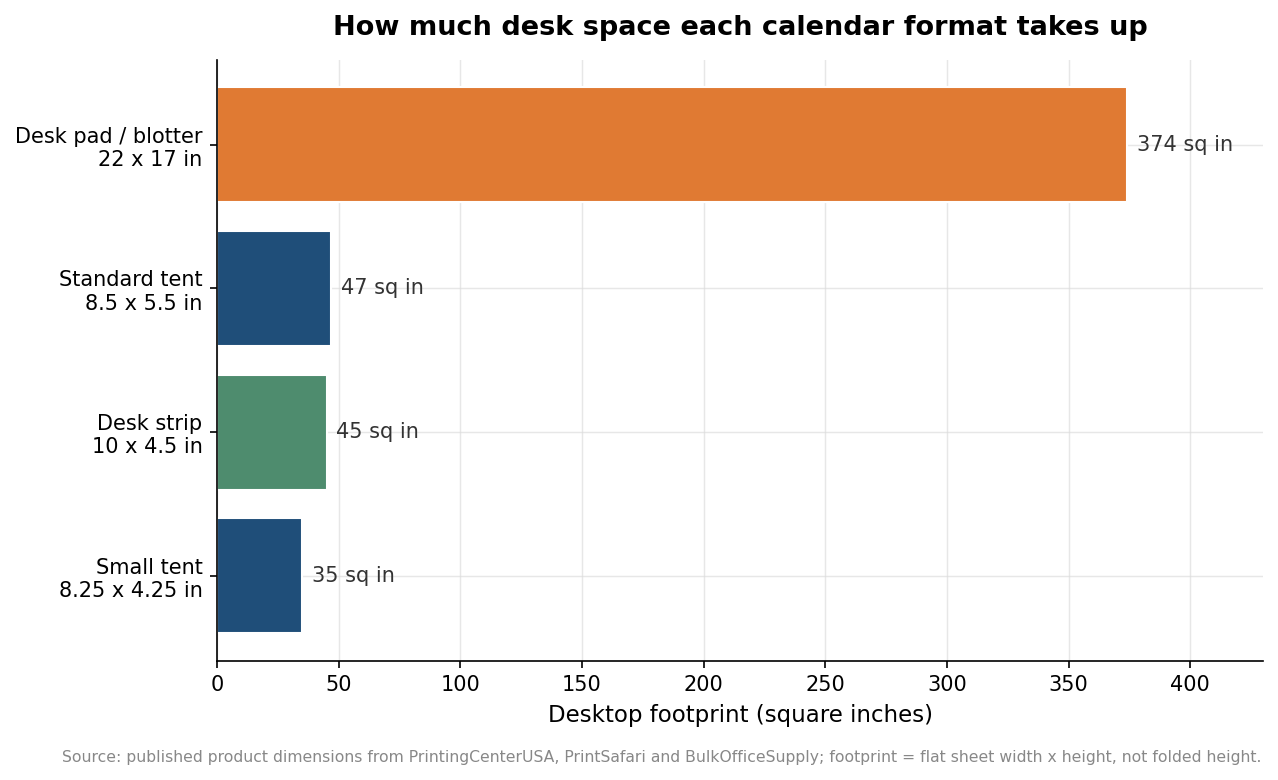
    Desktop calendars cluster around a handful of standard sizes, and the differences are more meaningful than the small numbers suggest. Two of the most widely printed tent footprints are roughly 8.5 by 5.5 inches and a more compact 8.25 by 4.25 inches, while the desk strip commonly runs about 10 by 4.5 inches. The wider 10-inch strip earns its length: it keeps room for holidays and a dedicated advertising or image area alongside the grid, whereas the smaller 8.5 by 5.5 block tends to fit only the dates and a picture. At the other extreme, the desk pad’s 22 by 17 inches is not really competing for the same corner of the desk at all.

    The practical takeaway is to think in terms of desktop footprint rather than page count. The chart below compares the flat sheet area of four common formats, and the gap between a tent calendar and a blotter is close to tenfold. If desks in your audience are cramped, the smaller tent formats are the safe default; if the calendar is meant to be a working surface, the blotter’s size is the point.

    Horizontal bar chart comparing desktop footprint in square inches of four custom desk calendar formats
    Desktop footprint of common desk calendar formats, from a 35-square-inch small tent to a 374-square-inch desk pad.

    Paper, binding, and how many sheets

    Most desktop calendars are bound along the top with Wire-O or a plastic spiral coil, which lets each month flip cleanly and lie back without tearing at the holes. Wire-O gives the tidier, more finished look and is the more common choice on tent and strip formats. Underneath the printed leaves sits a stiffer backer, usually a cardboard or heavy cover sheet that provides the rigidity the calendar stands on.

    Paper weight is where quality becomes visible. Interior leaves are frequently printed on a heavy book stock in the range of about 100 to 120 pound text, which resists curling and takes color well, while covers and backers step up to a cover-weight sheet, often something like 80 to 100 pound gloss cover. You will also choose a finish, typically a gloss or a matte coating; gloss makes photographs pop, while matte reads as more restrained and is easier to write on if the calendar has a notes area. On sheet count, a twelve-month calendar is usually built as thirteen leaves, a cover plus one per month, and sometimes fourteen when a separate title or planning page is added ahead of January. Confirm whether printing is one-sided or two, since a full-color front with a blank back costs less than color on both faces.

    Quantity and lead time drive the real cost

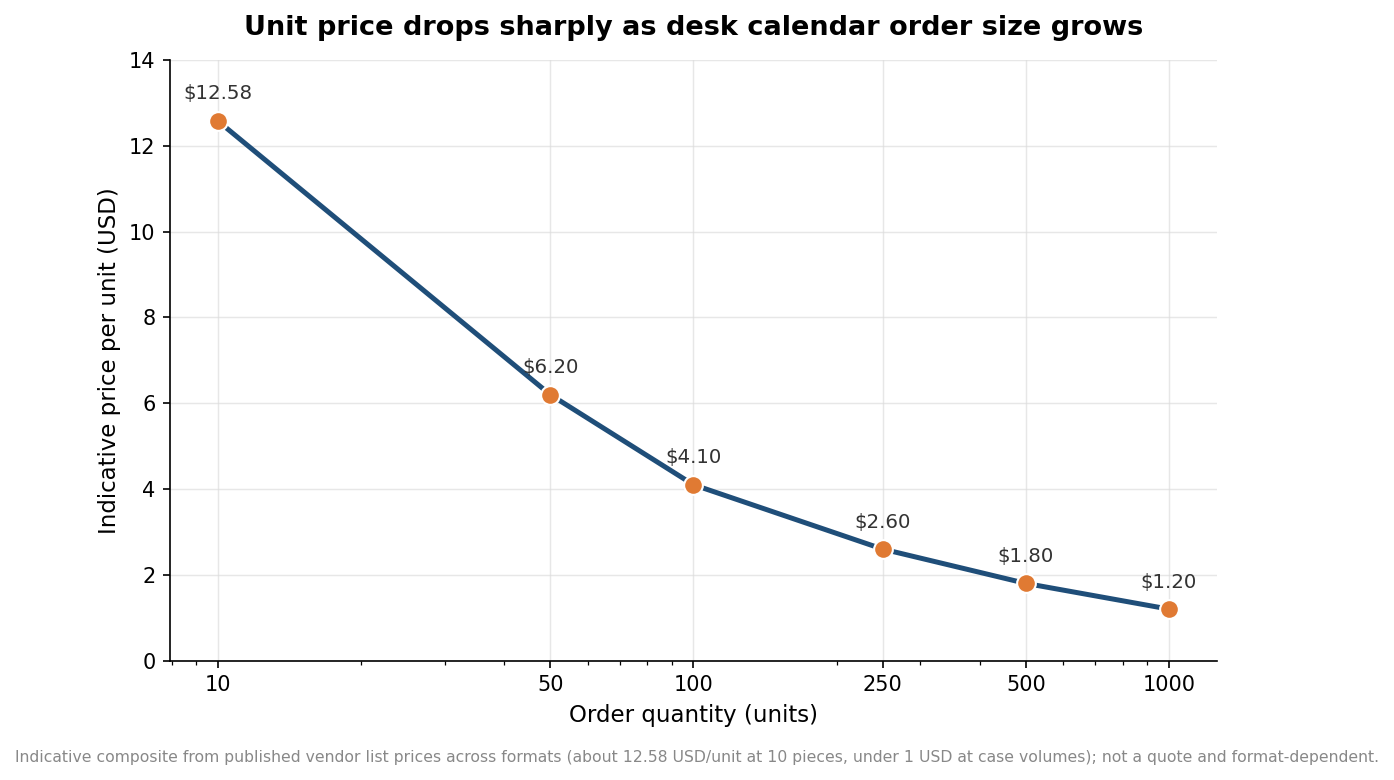
    Unit price on desk calendars is dominated by quantity, and the curve is steep at the low end. Published list prices show small runs landing around 12 to 13 dollars per unit at ten pieces, with the per-piece figure falling quickly into the low single digits as the order climbs into the hundreds, and dropping under a dollar at case and thousand-piece volumes. The chart below traces that indicative decline; treat it as a shape rather than a quote, because the exact numbers move with format, page count, and finish. The lesson is that ordering slightly more than you think you need is often nearly free per unit, while ordering a handful is expensive per unit.

    Line chart showing indicative per-unit price of desk calendars falling as order quantity rises from 10 to 1000
    Indicative per-unit price falls steeply as order quantity grows, based on published vendor list prices.

    Minimum order quantities vary widely by product. Some online printers will produce a single desk calendar, while promotional and wholesale lines often start at a case, and blotter products are sometimes sold only by the case of several dozen. Build lead time into the plan as well. Production typically begins once a print-ready file is approved, and many printers start the clock only if files arrive before a mid-morning cutoff. A realistic window for a standard run is on the order of one to three weeks from file approval to delivery, with shipping counted separately from production, and proofing adding a day or more if you want to see the artwork before the press runs. Because desk calendars are dated, this timing is unforgiving: a January-dated product ordered in December leaves no room for a reprint, so the safe move is to lock artwork well ahead of the season.

    Putting the specification together

    A complete desk calendar spec answers six questions in plain terms: which format, what flat size, what binding, what interior and cover paper with which finish, how many leaves printed on how many sides, and what quantity against what in-hand date. Decide the format and size for the desk it will live on, pick paper heavy enough that the pages do not curl, and let quantity be guided by the fact that the per-unit price rewards a larger run. Where a figure here is described as indicative, it reflects a range across vendors rather than a fixed rate, so use it to frame your questions to a printer rather than as a final number. Specified in that order, the calendar you approve on screen is the one that will sit on a desk twelve months from now.

  • Hello world!

    Welcome to WordPress. This is your first post. Edit or delete it, then start writing!